Mode: Classroom Offline (Pune – FC Road) / Live Virtual Online / Hybrid

Duration: 6 months

4.9 (24,598) reviews

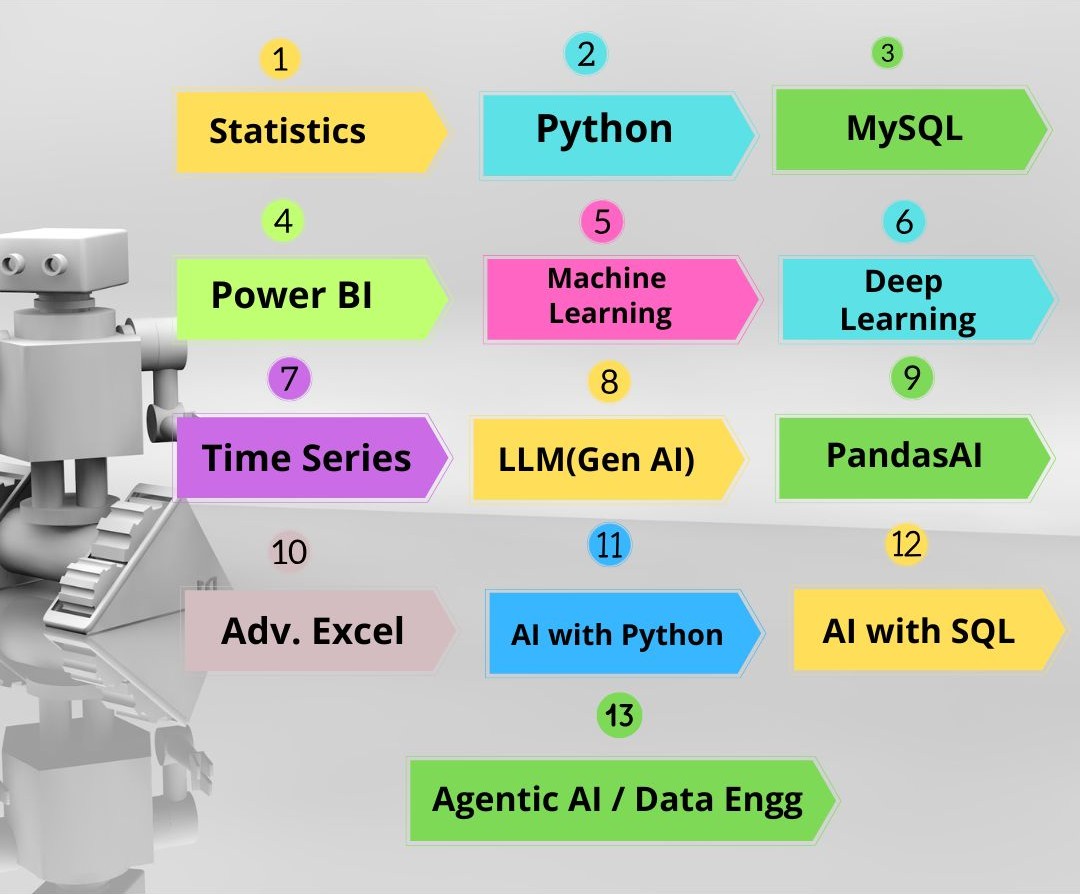
Statistics + Python + MySQL + Power BI + Machine Learning + Deep Learning + Time Series + LLM(Gen AI) + NumPy + Pandas + Plotly + PandasAI + Adv Excel + AI with Python + AI with SQL + AI with Power BI + Elective (Agentic AI or Data Engineering)

Bonus Free Content 🔥

✅ Internship and career mentorship programs till placements

Note: Separate batch & extra sessions for NON-IT Professionals to build strong programming skills from scratch.

Data Science, Data Analytics , Data Engineering & Agentic AI Course
Program Flow
  • The Python Ecosystem & Setup
  •  Scripting
  •  Functional Programming
  •  Conditional Statements and Loops
  •  UDF Functions and Object Functions
  •  File Handling with Python
  •  Exceptional Handling
  • Object-Oriented Python
  •  Advanced Topics
  •  Decorators, Descriptors, Debugging
  •  Framework & Regular expression
  •  Jupyter Notebook, Google Colab
  •  Python Libraries – NumPy,  Pandas
  •  Data Visualization
  •  Seaborn, Matplotlib , Plotly, Cufflinks
  •  EDA (Exploratory Data Analysis)
  •  Data Analytics using PandasAI
  • Anaconda AI Assistant, Gemini AI
  • Python with Gen AI

Introduction

  • What is a Database?
  • Importance of Databases in Real-World Applications
  • What is SQL (Structured Query Language)?
  • Understanding RDBMS (Relational Database Management Systems)
  • Advantages of Using SQL
  • Popular SQL Databases: MySQL, SQL Server, PostgreSQL, Oracle
  • SQL vs NoSQL Databases

Installation

  • Installing MySQL Workbench
  • Setting up MySQL Workbench
  • Understanding MySQL Workbench Interface

SQL Sublanguages

  • Overview of SQL Language Components - DDL (Data Definition Language)  -  CREATE, ALTER, DROP, TRUNCATE
  • DML (Data Manipulation Language) - INSERT, UPDATE, DELETE
  • DCL (Data Control Language) - GRANT, REVOKE
  • TCL (Transaction Control Language) - COMMIT, ROLLBACK, SAVEPOINT
  • DQL (Data Query Language) - SELECT & Role and Importance of Each Sublanguage in SQL

Data Types and Constraints

  • SQL Data Types (Numeric, Character, Date/Time)
  • Choosing Appropriate Data Types
  • SQL Constraints Overview - NOT NULL, UNIQUE, PRIMARY KEY, FOREIGN KEY, DEFAULT, CHECK
  • Applying Constraints While Creating Tables
  • Modifying and Dropping Constraints
  • Understanding Referential Integrity

SQL Clauses

  • SELECT Statement usage for Fetching Data
  • FROM, WHERE, ORDER BY, and DISTINCT Clauses
  • Filtering Data using WHERE
  • Sorting Data using ORDER BY
  • Using Aliases for Tables and Columns
  • Understanding LIMIT and OFFSET

Operators

  • Understanding Operators
  • Arithmetic Operators
  • Comparison Operators
  • Logical Operators
  • Bitwise Operators

Group By & Having Clause

  • Aggregating Data using GROUP BY
  • Aggregate Functions: SUM, AVG, COUNT, MIN, MAX
  • Filtering Aggregates using HAVING
  • Combining WHERE and HAVING in Queries
  • Grouping Multiple Columns

Conditionals

  • Using Conditional Logic in SQL
  • CASE WHEN THEN END Statements
  • Using IF and IFNULL / COALESCE
  • Handling NULL Values in Expressions
  • Conditional Aggregation Examples

Built-In Functions

  • String Functions
  • Date & Time Functions
  • Numeric Functions

UNION Operator

  • Understanding UNION and UNION ALL
  • Combining Results from Multiple Queries
  • Rules for UNION Compatibility
  • Removing Duplicates in UNION
  • Practical Use Cases of UNION

Subquery

  • Definition and Importance of Subqueries
  • Types of Subqueries – (Single Row Subquery, Multiple Row Subquery, Correlated Subquery
  • Nested Subqueries and Performance Optimization

Joins

  • Understanding Relationships Between Tables & Types of Joins – (INNER JOIN. LEFT JOIN, RIGHT JOIN, FULL OUTER JOIN, CROSS JOIN, SELF JOIN
  • Combining Multiple Joins
  • Real-Life Join Scenarios

Views

  • Introduction to Views
  • Creating and Managing Views
  • Simple vs Complex Views
  • Updatable Views and Limitations
  • Benefits of Using Views for Security and Simplification

Stored Procedures & Functions

  • What are Stored Procedures?
  • Creating and Executing Stored Procedures
  • Parameters (IN, OUT, INOUT)
  • Conditional Logic in Procedures
  • User Defined Functions (UDFs)
  • Difference Between Procedures and Functions

Introduction to Generative AI

  • What is Artificial Intelligence (AI)?
  • Difference between AI, Machine Learning (ML), Deep Learning (DL), and Generative AI
  • How Generative AI works (LLMs, prompt engineering basics)
  • Importance of Generative AI in database management and SQL
  • Real-world applications in analytics and automation

AI vs Generative AI

  • Traditional AI vs Generative AI: Key Differences
  • Capabilities of Generative AI
  • Role of Large Language Models (LLMs) in SQL Query Generation
  • How Gen AI Enhances Developer Productivity

Benefits of Combining SQL and AI

  • Speed & Productivity, Better Learning & Understanding, Industry Demand
  • Use of AI in Business Intelligence and Data Analysis
  • Skill-building for Future Data and AI Professionals

Use Cases of Gen AI with SQL

  • Auto-Generate Database Schema
  • Insert Mock / Sample Data
  • Generate Views, Procedures & Functions
  • SQL Query Optimization
  • Translate SQL Across Dialects
  • Explain SQL in Plain English
  • Add Comments Automatically

Gen AI Tools for SQL

  • ChatGPT, Copilot for SQL
  • Enterprise AI Tool
  • Best Practices for Using AI Tools Responsibly

Self-Learning Section / Assignments

  • Create a database schema & Sublanguages of SQL practice
  • Statistics for Data Science Intro
  • Central Tendency & Percentile
  • Euclidean Distance
  • Manhattan Distance
  • Normal Distribution & Its Properties
  • Sampling & Variables - Simple Random, Stratified, Systematic
  • Box Plot & Standardization
  • Types of probability in statistics - classical, empirical, subjective.
  • Hypothesis Testing
  • P-Value, Confidence interval and Steps in hypothesis testing
  • Question of Hypothesis Testing

Introduction to Machine Learning                                     

  • What is ML?
  • Types of ML - Regression and Classification

Linear Regression                                     

  • Introduction to linear regression
  • Rsquare, Adj Rsq, MSE, RMSE, MAPE
  • Regularization Technique
  • Ridge and Lasso's regression

Logistic Regression                                   

  • Introduction to Logistic regression
  • Confusion Matrix - Tpr, Fpr and all other evaluating Parameters.
  • Model Building on Logistic regression

Decision Tree

  • Introduction to DT
  • How DT works?
  • Hyper parameter
  • Model building

Random Forest                                          

  • Introduction to RF
  • Ensemble techniques in RF
  • Model building on RF

K-Nearest Neighbour(KNN)                                  

  • Introdction to KNN
  • How actually KNN works?
  • ModelBuilding on KNN

Naïve Bayes                                  

  • Introduction of NB
  • How NB works?
  • Model building

Support Vector Machine

  • Introduction to SVM and How it works?
  • Model building on SVM

Feature selection and Other ML techniques                                 

Boosting Algorithms                                 

  • Introduction and Model Building

Capstone Project                                      

  • End to End model building

Unsupervised Learning                                          

    • Introduction to unsupervised
    • Kmeans
    • PCA
    • Clustering

Deep Learning

  • Introduction to Deep Learning
  • What is Deep Learning
  • Why its so Important

Neural Networks                                       

  • Introduction to Neural Nets
  • Important concepts in NN
  • How to design NN
  • How NN exactly works
  • Model building on NN
  • Introduction to Text Analytics
  • Common concepts in NLP
  • How NLP works?
  • Model Building on NLP
  • Introduction to CNN
  • Layers in CNN
  • Model building on CNN
  • Introduction to OpenCV
  • Advance concepts related to CV
  • Practical on CV
  • Introduction to time series
  • Patterns in time series and stationarity
  • Model Building on Time series
  • ARIMA

Introduction

  • Overview of Excel as a Business Intelligence & Data Analysis Tool
  • Understanding the Excel Interface and Ribbon
  • Workbook vs Worksheet concepts
  • Customizing Excel Environment and Quick Access Toolbar
  • Importance of Excel Shortcuts for Productivity

Cell Referencing

  • Types of Cell References: Absolute, Relative, and Mixed
  • Practical Use Cases of Cell Referencing in Formulas
  • Named Ranges and their Advantages
  • Dynamic Named Ranges for Automation
  • Troubleshooting Cell Reference Errors

Formulas

  • Formula Syntax and Order of Precedence (PEMDAS)
  • Creating and Editing Formulas Efficiently
  • Using AutoSum, Formula Auditing, and Trace Tools
  • Handling Formula Errors (IFERROR, ISERROR, etc.)

Functions

  • Difference Between Formulas and Functions
  • Mathematical and Statistical Functions
  • Text Functions
  • Logical Functions
  • Date & Time Functions
  • Nesting Multiple Functions for Complex Calculations

Lookup Functions (VLOOKUP, HLOOKUP, XLOOKUP, INDEX-MATCH)

  • VLOOKUP and Its Limitations
  • Introduction to XLOOKUP – Replacing VLOOKUP/HLOOKUP
  • Using INDEX-MATCH for Dynamic Lookups
  • Two-Way Lookup using INDEX + MATCH
  • Handling Lookup Errors and Improving Efficiency

Dynamic Array Functions (FILTER, SORT, UNIQUE)

  • Understanding Dynamic Arrays and Spill Behavior
  • Using FILTER to Extract Data Dynamically
  • Sorting Data with SORT and SORTBY
  • Removing Duplicates using UNIQUE
  • Combining Dynamic Functions for Live Reports

Conditional Formatting

  • Applying Rules to Highlight Data (Greater Than, Text Contains, etc.)
  • Using Formulas within Conditional Formatting
  • Creating Data Bars, Icon Sets, and Color Scales

What-If Analysis & Scenario Tools

  • Introduction to What-If Analysis
  • Using Goal Seek for Target-Based Calculations
  • Creating Multiple Scenarios with Scenario Manager
  • Data Tables (One-Variable & Two-Variable Analysis)
  • Applying Solver for Optimization Problems

Connecting Excel to External Data Sources

  • Importing Data from CSV, Web, Databases, and Power BI
  • Using Data Tab Connectors (SQL, OData, SharePoint, etc.)
  • Data Refresh and Scheduled Updates
  • Combining Multiple Data Sources into One Table
  • Understanding
  • Linked Data Types

Power Query

  • Introduction to Power Query (ETL in Excel)
  • Loading Data from Multiple Sources
  • Data Cleaning and Transformation (Remove Duplicates, Pivot/Unpivot)
  • Merging and Appending Queries
  • Using Parameters and Custom Columns
  • Introduction to M Language

Power Pivot

  • Overview of Data Modeling in Excel
  • Creating Relationships Between Tables
  • Using the Data Model to Build PivotTables
  • Introduction to DAX (Data Analysis Expressions) in Excel
  • Calculated Columns, Measures, and KPIs
  • Advantages of Power Pivot over Traditional PivotTables

Charting Techniques

  • Designing Professional Charts (Column, Line, Pie, Combo, etc.)
  • Using Advanced Charts (Waterfall, Histogram, Box Plot, Pareto)
  • Creating Interactive Charts with Form Controls
  • Dynamic Charts using Named Ranges and Drop-downs
  • Chart Formatting Tips for Dashboards

Dashboard Creation

  • Planning and Designing a Dashboard Layout
  • Using Form Controls (Drop-downs, Sliders, Checkboxes)
  • Integrating Charts, Tables, and KPIs
  • Using Slicers and Timelines for Interactivity
  • Automating Dashboard Updates with Power Query & Pivot
  • Dashboard Design Best Practices (Color, Layout, Readability)

Macros & VBA Automation

  • Introduction to Macros and Recording Basic Tasks
  • Understanding VBA Editor and Code Structure
  • Writing Simple VBA Scripts for Automation
  • Creating User Forms and Buttons
  • Error Handling and Debugging in VBA
  • Practical Examples: Report Automation, Data Cleanup, File Handling

Introduction to AI in Excel

  • Understanding the role of AI in modern Excel
  • Difference between Traditional Excel and AI-Powered Excel
  • Overview of AI features: Analyze Data, Copilot, and Smart Plugins
  • How AI enhances productivity, accuracy, and reporting speed

Analyze Data Feature using AI

  • What is the “Analyze Data” tool in Excel?
  • Exploring the Ideas Pane for instant insights
  • Automatically generating PivotTables, Charts, and Summaries
  • Using Natural Language Queries to ask questions about your data
  • Real-time examples: Sales summary, trend detection, and key drivers

Excel Copilot Integration using AI

  • Introduction to Microsoft 365 Copilot in Excel
  • Using Natural Language to:
    • Write formulas
    • Clean or transform data
    • Create charts or tables automatically
  • Generating trend analysis, forecasts, and summaries using prompts
  • Reviewing, editing, and validating Copilot-generated content
  • Limitations and best practices for using Copilot responsibly

Generating VBA Scripts using AI

  • Introduction to AI-assisted VBA generation
  • Using AI Tools to automate repetitive Excel tasks
  • Generating VBA code for:
    • Data cleaning and formatting
    • Report automation and file handling
    • Custom user forms or buttons
  • Understanding and modifying AI-generated VBA scripts
  • Debugging, validating, and improving code efficiency with AI suggestions
  • Best practices and security considerations when using AI for automation

Introduction

  • What is Business Intelligence (BI)?
  • Overview of Power BI and its ecosystem
  • Components of Power BI (Desktop, Service, Mobile)
  • Understanding data-driven decision-making

Installation & Get Data

  • Installing Power BI Desktop
  • Overview of Power BI Interface
  • Understanding Data Sources 
  • Connecting to different data sources 
  • Import vs. Direct Query mode
  • Data Refresh concepts

Power Query Editor

  • Introduction to Power Query (ETL Process)
  • Data Cleaning and Transformation
  • Removing duplicates, handling errors, and missing data
  • Column operations: Split, Merge, Replace, Fill
  • Data type conversion and formatting
  • Appending and Merging queries
  • Using Parameters in Power Query
  • Introduction to M language 

Data Modeling

  • Importance of Data Modeling in BI
  • Understanding Relationships (One-to-One, One-to-Many, Many-to-Many)
  • Creating and Managing Relationships in Power BI
  • Star vs Snowflake Schema
  • Role of Fact and Dimension tables

Data Visualization

  • Introduction to Power BI Visuals
  • Creating Built in Visuals
  • Color and Conditional Formatting 
  • Slicers, Filters, and Bookmarks
  • Drill Through, Drill Down, and Tooltip pages
  • Using Themes and Custom Visuals
  • Designing Interactive Reports
  • Report Design Best Practices and Storytelling with Data

DAX (Data Analysis Expressions)

  • Introduction to DAX
  • Calculated Columns vs. Measures
  • Aggregation Functions
  • Filter Functions
  • Logical Functions
  • Text Functions
  • Date & Time Functions
  • Time Intelligence Functions 
  • Relationship Functions
  • Parent & Child Functions
  • Performance optimization and debugging DAX

Power BI Project (End-to-End Implementation)

  • Selecting a real-world dataset (Excel/SQL/Web)
  • Requirement gathering 
  • Data import and cleaning using Power Query
  • Data model designing
  • Creating calculated columns and measures
  • Building interactive visuals and Reports
  • Adding narrative and filters for user interaction

Power BI Service Overview

  • Introduction to Power BI Service 
  • Publishing and Sharing Reports from Power BI Desktop
  • Creating and Managing Workspaces
  • Building and Sharing Dashboards Online
  • App Creation and Distribution
  • Collaboration and Permissions in Power BI Service
  • Scheduling Data Refresh and Alerts

Introduction to AI in Power BI

  • Overview of AI capabilities in Power BI
  • Understanding how AI enhances analytics and insights
  • Types of AI features in Power BI

Forecasting using AI

  • Using Forecasting in Line Charts
  • Configuring Confidence Intervals and Forecast Length
  • Analyzing Seasonality and Trends
  • Comparing Actual vs. Predicted values
  • Best practices for forecasting accuracy

Anomaly Detection using AI

  • Enabling and Configuring Anomaly Detection
  • Understanding Sensitivity and Expected Range
  • Visualizing anomalies on time series data
  • Explaining anomaly causes and patterns

Explain the Variation using AI

  • Using “Explain the Increase/Decrease” feature
  • Understanding key drivers behind data change
  • Interpreting AI-generated insights
  • Turning insights into actionable decisions

AI Visuals

  • Smart Narrative Visual 
  • Q&A Visual 
  • Decomposition Tree Visual
  • Key Influencers Visual
  • Using AI visuals effectively in storytelling

Copilot Integration

  • Introduction to Power BI Copilot
  • Generating Reports and Summaries with Natural Language Prompts
  • Asking questions and creating visuals using Copilot
  • Enhancing productivity through AI assistance
  • Best practices and limitations of Copilot

DAX & M Code Generation using AI

  • Using Copilot to write and explain DAX formulas
  • Generating M queries in Power Query using AI suggestions
  • Validating and editing AI-generated code
  • Combining AI with human logic for optimized results

Far far away, behind the word mountains, far from the countries Vokalia and Consonantia, there live the blind texts. Separated they live in Bookmarksgrove right at the coast

(Self Paced)

Understanding MongoDB

  • NoSQL Databases
  • JSON and BSON
  • Vertical and Horizontal Scaling
  • Data Types
  • MongoDB Tools
  • Collection and Database
  • Schema Design and Modeling
  • CRUD Operations in MongoDB
  • Indexing and Aggregation
  • Replication and Sharding
  • MongoDB Cluster Operations

(Self Paced)

  • Introduction to Tableau
  • Installation of Tableau Desktop
  • Connectors & Interface of Tableau
  • Types of Data & Data Modeling
  • Data Modeling Practical
  • Tableau Joins (Theory + Practical)
  • Viz_01 - Bar & Column Chart
  • Viz_02 - Axis less Viz
  • Viz_03 - Line & Area Charts
  • Viz_04 - Variants of Column Charts, Maps & Custom Visualization (Donut Chart)
  • Viz_05 - Custom Charts - KPI & Waterfall
  • Viz_06 : Pareto & Statistical Chart
  • Group & Bins
  • Sets In Tableau
  • Filters : Dimension, Measure & Relative
  • Filters : Data Source, Contex
  • Calculated Fields
  • Parameter
  • Level of Details (LOD) Expressions
  • Project Workflow & Initial Setup
  • Final Dashboard Building

LLM Fundamentals:

  • What Are Large Language Models?
  • History and Evolution of LLMs Part 1
  • History and Evolution of LLMs Part 2
  • Key Differences Between LLMs and Traditional Models
  • Popular LLMs: GPT, PaLM, Claude, LLaMA, Gemini Part 1
  • Popular LLMs: GPT, PaLM, Claude, LLaMA, Gemini Part 2

Reinforcement Learning & LLM

  • Transformers and the Architecture Behind LLMs
  • Pre-training vs Fine-tuning
  • Tokens, Context Windows, and Model Parameters
  • Prompt Engineering Basics
  • Techniques, Tips & Mistakes to Avoid
  • Deep Dive into LLMs & Prompt Engineering
  • Communication & Presentation Skills
  • Problem-solving & Critical Thinking
  • Collaboration & Teamwork
  • Hands-on Capstone Projects
  • Internship Opportunity
Enquire Now

Free consulting from our expert

Our Process

Executive PGP in Full Stack Data Science &
Data Analytics with Specialization in
Agentic AI or Data Engg

17 Modules

50% OFF

₹ 90,000/-  ₹ 44,900/-
2 Installments:

₹ 22,450/- (15 days gap)

Down Payment:

₹ 39,900/-

👉 Book your seat now with just ₹500 advance payment!

✨ LIMITED SEATS – HURRY UP!

💳 Pay Instantly via Razorpay:
Pratik Rawade

The Python course at Gamaka AI was a great learning experience. The curriculum was well-structured, covering everything from basic syntax to advanced concepts like data structures and OOP. The hands-on approach and real-world applications made learning engaging. The instructors were knowledgeable and provided clear explanations. Good staff and Excellent teaching , Communication is good also Placement is good.

Devesh Mishra

I recently completed the Python module at Gamaka AI Institute in Pune, and I’m really happy with the training experience. The course was structured very well, and the trainer explained all the concepts clearly, making it easy to understand even complex topics. What I appreciated most is that the training is real-time and project-oriented, which helped me gain practical, hands-on experience. The trainer is knowledgeable, patient, and always ready to help.

Darshana Rindhe

I recently enrolled in a Data Science course at gamakaai, and my SQL module just got completed. The experience so far has been really good! The concepts were explained clearly, and the practical examples helped me understand how to use SQL in real-life scenarios. I'm excited to continue rest of the course.

Aniket Dharwadkar

Comprehensive courses at affordable prices.

Mayur Parthe

The Python course was well-structured and beginner-friendly. The concepts were explained in a simple and easy-to-understand manner, with plenty of hands-on examples. I appreciated the step-by-step guidance, interactive exercises, and real-world projects that helped reinforce learning. Overall, it was a great experience and a solid foundation for anyone starting their Python journey.

Gandhali Vaidya

I'm currently taking a course on Power BI and SQL, and it's been a great experience so far. The content is clear, practical, and beginner-friendly — especially for someone like me transitioning into data analytics. Power BI has helped me understand how to build dashboards and visualize insights, while SQL has made querying and handling data much easier to grasp. Overall, it’s a solid foundation for anyone looking to start a career in data or business intelligence.

Deepesh Thakur

I enrolled in the Data Analytics course at Gamaka AI and had a great experience. The curriculum is well-structured, covering tools like Excel, SQL, Python, and Power BI with a strong focus on practical learning. The trainers are knowledgeable and supportive, and the hands-on projects really helped me apply what I learned. The placement support, including resume guidance and interview prep, is also very useful. Overall, it's a solid course for anyone looking to start a career in data analytics.

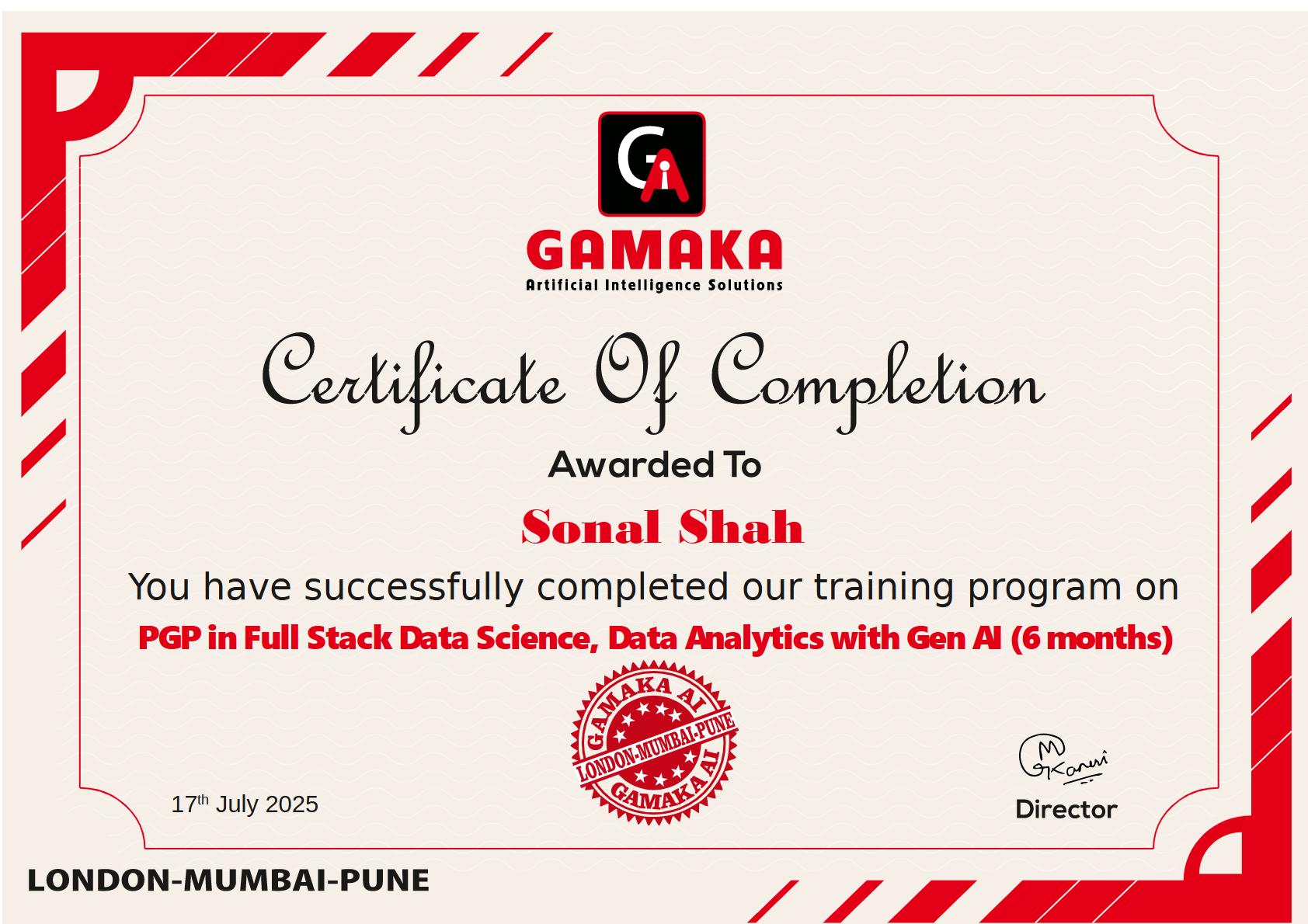
Course Certificate

Upon successful completion of this data science course, you’ll earn a Certificate. The certificate adds the required weight in any portfolio.

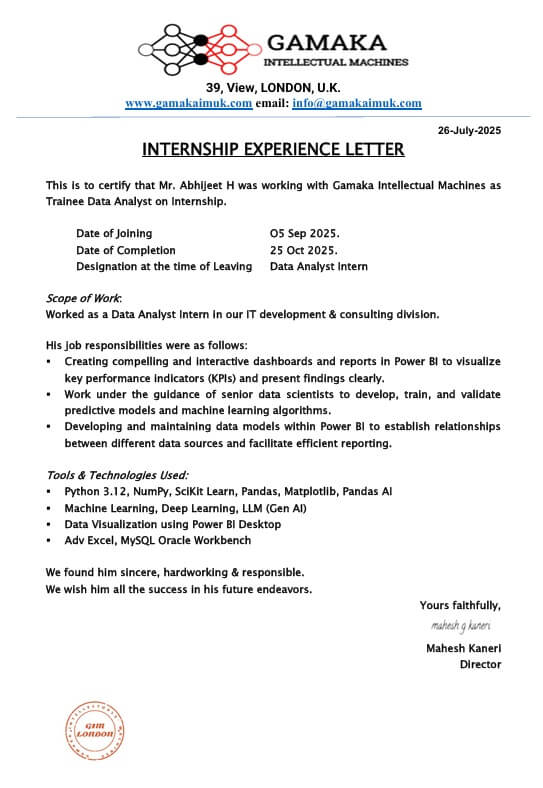
Internship Certificate

This certificate will be issued to those pursuing internships with our development team or clients with whom we have tie-ups. Data Science Internship gives opportunity to learn from professionals, gain practical experience in this field, and build a robust professional network.

Take First Step Towards
Your IT Dream Today

High Demand

The demand for skilled data science professionals is booming across all sectors. Data scientists are well-compensated, and the field offers a multitude of exciting career paths. If you’re passionate about problem-solving, enjoy working with data, and have an analytical mind, then data science could be the perfect career choice for you.

WHY PURSUE A DATA SCIENCE CAREER
Who can take this course

This program is designed for individuals aiming to enter the data science field, with or without prior technical experience. We offer both weekday and special weekend batches to accommodate working professionals.

Hands-on Projects & Internship

Gain practical experience by real-world projects and participating in an internship.

Expert Instructors

Learn from data science professionals with real-world experience who will guide you through the program and answer your questions.

Industry Based Curriculum

Our curriculum is designed to equip you with the specific skills and knowledge that are in high demand by today’s data science employers.

100% Placement

We’ll equip you with the skills and support you need to land your dream data science job.

Real World Case Studies

Immerse yourself in real-world scenarios by exploring how data science is applied in various industries.

Extensive coverage on AI Tools

Use AI to clean, transform, and organize data efficiently. Saves time spent on repetitive data tasks.

Enquire Now

Free consulting from our expert

Take First Step Towards
Your IT Dream Today