Mode: Classroom Offline (Pune – FC Road & Kothrud) / Live Virtual Online / Hybrid

Duration: 4 months

4.9 (24,598) reviews

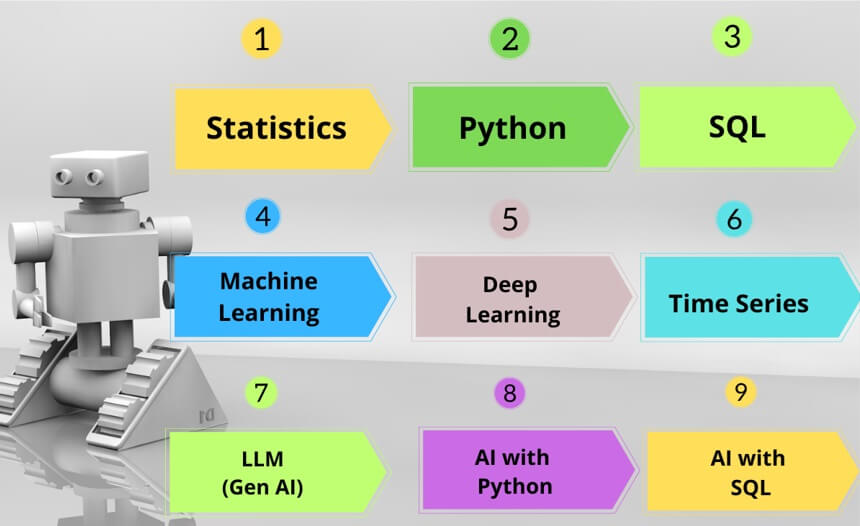
Statistics + Python + MySQL + NumPy + Pandas + Plotly + PandasAI + EDA + Time Series + Machine Learning + Deep Learning + LLM(Gen AI)Ā  + AI with Python + AI with SQL + AI with Power BI

Bonus Free Content šŸ”„

āœ… Internship and career mentorship programs till placements

Note: Separate batch & extra sessions for NON-IT Professionals to build strong programming skills from scratch.

Program Flow

Ā Python Ecosystem & Environment Setup

  • Introduction to Python and its use cases
  • Installing Python (Windows/Linux/macOS)
  • Python distributions and package managers
  • Virtual environments
  • IDEs and editors (VS Code, PyCharm)
  • Introduction to Anaconda Distribution

Ā 

Python Scripting Basics

  • Python syntax and indentation
  • Variables and data types
  • Input/output operations
  • Writing and executing Python scripts
  • Command-line execution

Ā 

Functional Programming in Python

  • Functions and return values
  • Arguments and parameters
  • Lambda functions
  • Map, filter, and reduce
  • List, tuple, set, and dictionary comprehensions

Ā 

Control Flow

  • Conditional statements (if, elif, else)
  • Looping constructs (for, while)
  • Break, continue, and pass
  • Nested loops
  • Pattern-based problems

Ā 

Functions and Built-in Objects

  • User-Defined Functions (UDFs)
  • Scope and lifetime of variables
  • Built-in functions and modules
  • Docstrings and annotations

Ā 

File Handling with Python

  • Reading and writing files
  • Working with CSV, TXT, and JSON files
  • File modes and file pointers
  • Context managers (with statement)

Ā 

Exception Handling

  • Types of errors in Python
  • Try, except, else, finally blocks
  • Custom exceptions
  • Debugging common runtime errors

Ā 

Object-Oriented Programming (OOP)

  • Classes and objects
  • Constructors and destructors
  • Encapsulation, inheritance, and polymorphism
  • Method overriding and operator overloading
  • Magic (dunder) methods

Ā 

Advanced Python Concepts

  • Decorators and closures
  • Descriptors
  • Iterators and generators
  • Debugging techniques and tools

Ā 

Frameworks & Regular Expressions

  • Introduction to Python frameworks
  • Basics of Regular Expressions (regex)
  • Pattern matching and text processing
  • Practical regex use cases

Ā 

Development & Notebook Tools

  • Jupyter Notebook fundamentals
  • Markdown and magic commands
  • Google Colab workflow
  • Version control basics with Git

Ā 

Python Libraries for Data Analysis

  • NumPy arrays and operations
  • Pandas Series and DataFrames
  • Data cleaning and transformation
  • Handling missing data

Ā 

Data Visualization

  • Visualization principles
  • Matplotlib basics
  • Seaborn for statistical plots
  • Interactive visualization with Plotly and Cufflinks

Ā 

Ā 

Exploratory Data Analysis (EDA)

  • Data understanding and summarization
  • Univariate and bivariate analysis
  • Correlation and feature insights
  • EDA case studies

Ā 

Data Analytics using PandasAI

  • Introduction to PandasAI
  • Natural language queries on datasets
  • Data insights using AI-assisted analysis

Ā 

AI Assistants & Productivity Tools

  • Anaconda AI Assistant overview
  • Gemini AI integration concepts
  • Responsible AI usage

Ā 

Python with Generative AI

  • Introduction to Generative AI
  • Using Python with GenAI APIs
  • Prompt engineering basics
  • Simple GenAI-powered applications

Ā 

Capstone Project

  • End-to-end Python project
  • Data analysis and visualization
  • Documentation and presentation

Ā 

Introduction

  • What is a Database?
  • Importance of Databases in Real-World Applications
  • What is SQL (Structured Query Language)?
  • Understanding RDBMS (Relational Database Management Systems)
  • Advantages of Using SQL
  • Popular SQL Databases: MySQL, SQL Server, PostgreSQL, Oracle
  • SQL vs NoSQL Databases

Ā 

Installation

  • Installing MySQL Workbench
  • Setting up MySQL Workbench
  • Understanding MySQL Workbench Interface

Ā 

SQL Sublanguages

  • Overview of SQL Language Components - DDL (Data Definition Language) Ā -Ā  CREATE, ALTER, DROP, TRUNCATE
  • DML (Data Manipulation Language) - INSERT, UPDATE, DELETE
  • DCL (Data Control Language) - GRANT, REVOKE
  • TCL (Transaction Control Language) - COMMIT, ROLLBACK, SAVEPOINT
  • DQL (Data Query Language) - SELECT & Role and Importance of Each Sublanguage in SQL

Ā 

Data Types and Constraints

  • SQL Data Types (Numeric, Character, Date/Time)
  • Choosing Appropriate Data Types
  • SQL Constraints Overview - NOT NULL, UNIQUE, PRIMARY KEY, FOREIGN KEY, DEFAULT, CHECK
  • Applying Constraints While Creating Tables
  • Modifying and Dropping Constraints
  • Understanding Referential Integrity

Ā 

SQL Clauses

  • SELECT Statement usage for Fetching Data
  • FROM, WHERE, ORDER BY, and DISTINCT Clauses
  • Filtering Data using WHERE
  • Sorting Data using ORDER BY
  • Using Aliases for Tables and Columns
  • Understanding LIMIT and OFFSET

Ā 

Operators

  • Understanding Operators
  • Arithmetic Operators
  • Comparison Operators
  • Logical Operators
  • Bitwise Operators

Ā 

Group By & Having Clause

  • Aggregating Data using GROUP BY
  • Aggregate Functions: SUM, AVG, COUNT, MIN, MAX
  • Filtering Aggregates using HAVING
  • Combining WHERE and HAVING in Queries
  • Grouping Multiple Columns

Ā 

Conditionals

  • Using Conditional Logic in SQL
  • CASE WHEN THEN END Statements
  • Using IF and IFNULL / COALESCE
  • Handling NULL Values in Expressions
  • Conditional Aggregation Examples

Ā 

Built-In Functions

  • String Functions
  • Date & Time Functions
  • Numeric Functions

Ā 

UNION Operator

  • Understanding UNION and UNION ALL
  • Combining Results from Multiple Queries
  • Rules for UNION Compatibility
  • Removing Duplicates in UNION
  • Practical Use Cases of UNION

Ā 

Subquery

  • Definition and Importance of Subqueries
  • Types of Subqueries – (Single Row Subquery, Multiple Row Subquery, Correlated Subquery
  • Nested Subqueries and Performance Optimization

Ā 

Joins

  • Understanding Relationships Between Tables & Types of Joins – (INNER JOIN. LEFT JOIN, RIGHT JOIN, FULL OUTER JOIN, CROSS JOIN, SELF JOIN
  • Combining Multiple Joins
  • Real-Life Join Scenarios

Ā 

Views

  • Introduction to Views
  • Creating and Managing Views
  • Simple vs Complex Views
  • Updatable Views and Limitations
  • Benefits of Using Views for Security and Simplification

Ā 

Stored Procedures & Functions

  • What are Stored Procedures?
  • Creating and Executing Stored Procedures
  • Parameters (IN, OUT, INOUT)
  • Conditional Logic in Procedures
  • User Defined Functions (UDFs)
  • Difference Between Procedures and Functions

Ā 

Benefits of Combining SQL and AI

  • Speed & Productivity, Better Learning & Understanding, Industry Demand
  • Use of AI in Business Intelligence and Data Analysis
  • Skill-building for Future Data and AI Professionals

Ā 

Use Cases of Gen AI with SQL

  • Auto-Generate Database Schema
  • Insert Mock / Sample Data
  • Generate Views, Procedures & Functions
  • SQL Query Optimization
  • Translate SQL Across Dialects
  • Explain SQL in Plain English
  • Add Comments Automatically

Ā 

Gen AI Tools for SQL

  • ChatGPT, Copilot for SQL
  • Enterprise AI Tool
  • Best Practices for Using AI Tools Responsibly
  • Statistics for Data Science Intro
  • Central Tendency & Percentile
  • Euclidean Distance
  • Manhattan Distance
  • Normal Distribution & Its Properties
  • Sampling & Variables - Simple Random, Stratified, Systematic
  • Box Plot & Standardization
  • Types of probability in statistics - classical, empirical, subjective.
  • Hypothesis Testing
  • P-Value, Confidence interval and Steps in hypothesis testing
  • Question of Hypothesis Testing
  • Introduction to time series
  • Patterns in time series and stationarity
  • Model Building on Time series
  • ARIMA
  • SARIMA

Introduction to Machine LearningĀ Ā Ā Ā  Ā Ā Ā Ā Ā Ā Ā Ā Ā Ā Ā Ā Ā Ā Ā Ā Ā Ā Ā Ā Ā Ā Ā Ā Ā Ā Ā Ā Ā Ā Ā Ā 

  • What is ML?
  • Types of ML - Regression and Classification

Ā 

Linear RegressionĀ Ā Ā Ā Ā Ā Ā Ā Ā Ā Ā Ā Ā Ā Ā Ā Ā Ā Ā Ā Ā Ā Ā Ā Ā Ā Ā Ā Ā Ā Ā Ā Ā Ā Ā Ā Ā 

  • Introduction to linear regression
  • Rsquare, Adj Rsq, MSE, RMSE, MAPE
  • Regularization Technique
  • Ridge and Lasso's regression

Ā 

Logistic RegressionĀ Ā Ā Ā Ā Ā Ā Ā Ā Ā Ā Ā Ā Ā Ā Ā Ā Ā Ā Ā Ā Ā Ā Ā Ā Ā Ā Ā Ā Ā Ā Ā Ā Ā Ā 

  • Introduction to Logistic regression
  • Confusion Matrix - Tpr, Fpr and all other evaluating Parameters.
  • Model Building on Logistic regression

Ā 

Decision Tree

  • Introduction to DT
  • How DT works?
  • Hyper parameter
  • Model building

Ā 

Random ForestĀ Ā Ā Ā Ā Ā Ā Ā Ā Ā Ā Ā Ā Ā Ā Ā Ā Ā Ā Ā Ā Ā Ā Ā Ā Ā Ā Ā Ā Ā Ā Ā Ā Ā Ā Ā Ā Ā Ā Ā Ā Ā 

  • Introduction to RF
  • Ensemble techniques in RF
  • Model building on RF

Ā 

K-Nearest Neighbour(KNN)Ā Ā Ā Ā Ā Ā Ā Ā Ā Ā Ā Ā Ā Ā Ā Ā Ā Ā Ā Ā Ā Ā Ā Ā Ā Ā Ā Ā Ā Ā Ā Ā Ā Ā 

  • Introdction to KNN
  • How actually KNN works?
  • ModelBuilding on KNN

Ā 

NaĆÆve BayesĀ Ā Ā Ā Ā Ā Ā Ā Ā Ā Ā Ā Ā Ā Ā Ā Ā Ā Ā Ā Ā Ā Ā Ā Ā Ā Ā Ā Ā Ā Ā Ā Ā Ā 

  • Introduction of NB
  • How NB works?
  • Model building

Ā 

Support Vector Machine

  • Introduction to SVM and How it works?
  • Model building on SVM

Ā 

Feature selection and Other ML techniquesĀ Ā Ā Ā Ā Ā Ā Ā Ā Ā Ā Ā Ā Ā Ā Ā Ā Ā Ā Ā Ā Ā Ā Ā Ā Ā Ā Ā Ā Ā Ā Ā Ā 

Ā 

Boosting AlgorithmsĀ Ā Ā Ā Ā Ā Ā Ā Ā Ā Ā Ā Ā Ā Ā Ā Ā Ā Ā Ā Ā Ā Ā Ā Ā Ā Ā Ā Ā Ā Ā Ā Ā 

  • Introduction and Model Building

Ā 

Capstone ProjectĀ Ā Ā Ā Ā Ā Ā Ā Ā Ā Ā Ā Ā Ā Ā Ā Ā Ā Ā Ā Ā Ā Ā Ā Ā Ā Ā Ā Ā Ā Ā Ā Ā Ā Ā Ā Ā Ā 

  • End to End model building

Ā 

Unsupervised LearningĀ Ā Ā Ā Ā Ā Ā Ā Ā Ā Ā Ā Ā Ā Ā Ā Ā Ā Ā Ā Ā Ā Ā Ā Ā Ā Ā Ā Ā Ā Ā Ā Ā Ā Ā Ā Ā Ā Ā Ā Ā Ā 

      • Introduction to unsupervised
      • Kmeans
      • PCA
      • Clustering

Deep Learning

  • Introduction to Deep Learning
  • What is Deep Learning
  • Why its so Important

Ā 

Neural NetworksĀ Ā Ā Ā Ā Ā Ā Ā Ā Ā Ā Ā Ā Ā Ā Ā Ā Ā Ā Ā Ā Ā Ā Ā Ā Ā Ā Ā Ā Ā Ā Ā Ā Ā Ā Ā Ā Ā Ā 

    • Introduction to Neural Nets
    • Important concepts in NN
    • How to design NN
    • How NN exactly works
    • Model building on NN
  • Introduction to Text Analytics
  • Common concepts in NLP
  • How NLP works?
  • Model Building on NLP
  • Introduction to CNN
  • Layers in CNN
  • Model building on CNN
  • Introduction to OpenCV
  • Advance concepts related to CV
  • Practical on CV

LLM Fundamentals:

  • What Are Large Language Models?
  • History and Evolution of LLMs Part 1
  • History and Evolution of LLMs Part 2
  • Key Differences Between LLMs and Traditional Models
  • Popular LLMs: GPT, PaLM, Claude, LLaMA, Gemini Part 1
  • Popular LLMs: GPT, PaLM, Claude, LLaMA, Gemini Part 2

Ā 

Reinforcement Learning & LLM

  • Transformers and the Architecture Behind LLMs
  • Pre-training vs Fine-tuning
  • Tokens, Context Windows, and Model Parameters
  • Prompt Engineering Basics
  • Techniques, Tips & Mistakes to Avoid
  • Deep Dive into LLMs & Prompt Engineering
  • Communication & Presentation Skills
  • Problem-solving & Critical Thinking
  • Collaboration & Teamwork
  • Hands-on Capstone Projects
  • Internship Opportunity
Enquire Now

Free consulting from our expert

Our Process

Executive PGP in Data Science & Machine Learning with AI

12 Modules

50% OFF

₹ 70,000/-Ā  ₹ 34,900/-
2 Installments:

₹ 17,200/- (15 days gap)

Down Payment:

₹ 29,900/-

šŸ‘‰ Book your seat now with just ₹500 advance payment!

✨ LIMITED SEATS – HURRY UP!

šŸ’³ Pay Instantly via Razorpay:
Jaya Nagpure

I recently attended Python classes in Pune, and I must say, it was an amazing learning experience! The instructor was highly knowledgeable, patient, and always ready to clear doubts. The course structure was well-organized, covering everything from basic syntax to more advanced concepts like data structures, algorithms, and libraries like Pandas and NumPy. The practical approach to learning was very beneficial. I had the opportunity to work on hands-on projects, which helped me apply the concepts in real-world scenarios. The learning environment was comfortable, and the class size was perfect for one-on-one attention. I also appreciated the availability of online resources and regular assignments that helped reinforce the material. If you're looking to learn Python in Pune, I highly recommend this course. It’s a great value for both beginners and those looking to level up their skills!

Pratik Rawade

The Python course at Gamaka AI was a great learning experience. The curriculum was well-structured, covering everything from basic syntax to advanced concepts like data structures and OOP. The hands-on approach and real-world applications made learning engaging. The instructors were knowledgeable and provided clear explanations. Good staff and Excellent teaching , Communication is good also Placement is good.

Devesh Mishra

I recently completed the Python module at Gamaka AI Institute in Pune, and I’m really happy with the training experience. The course was structured very well, and the trainer explained all the concepts clearly, making it easy to understand even complex topics. What I appreciated most is that the training is real-time and project-oriented, which helped me gain practical, hands-on experience. The trainer is knowledgeable, patient, and always ready to help.

Darshana Rindhe

I recently enrolled in a Data Science course at gamakaai, and my SQL module just got completed. The experience so far has been really good! The concepts were explained clearly, and the practical examples helped me understand how to use SQL in real-life scenarios. I'm excited to continue rest of the course.

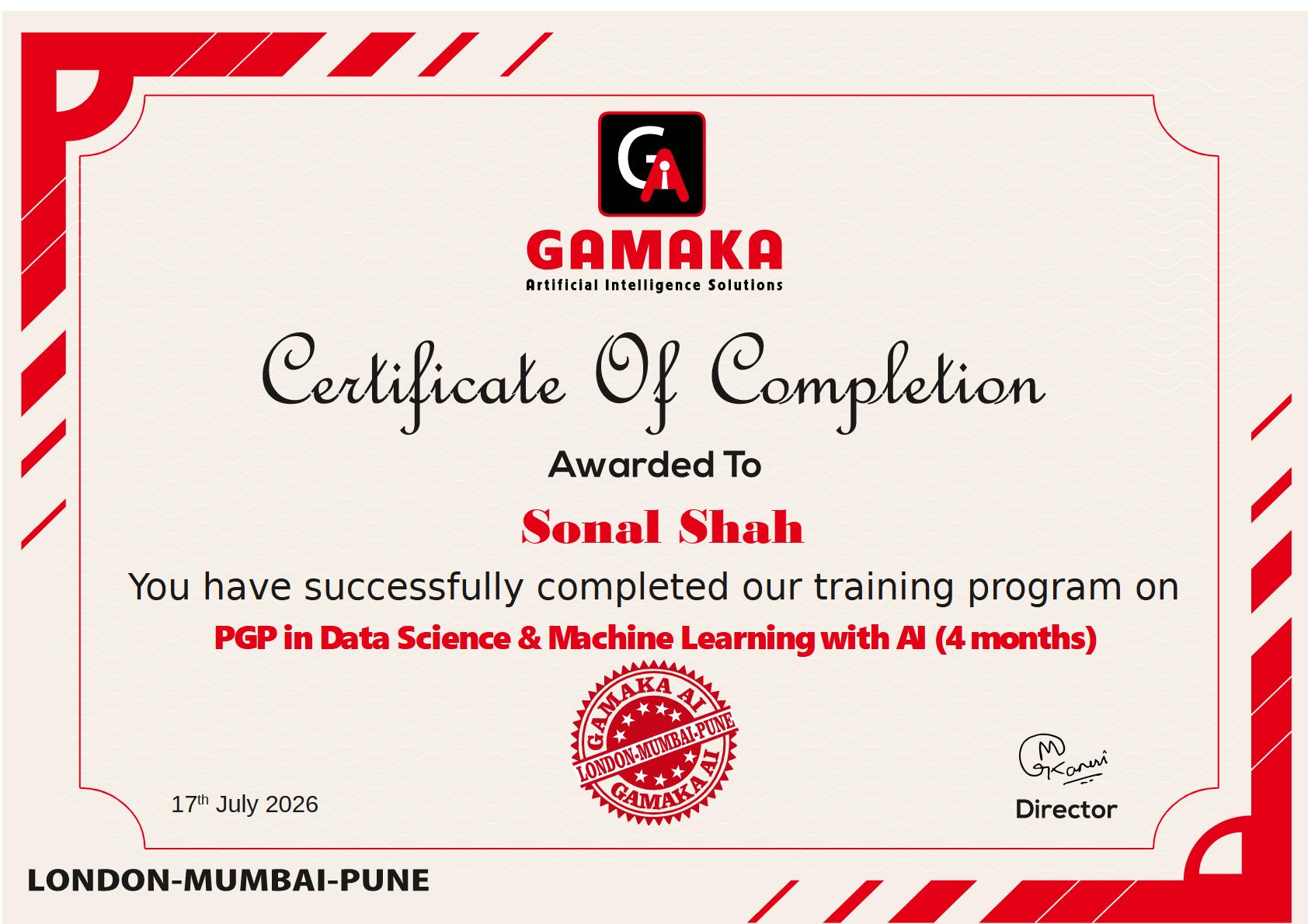
Course Certificate

Upon successful completion of this data science course, you’ll earn a Certificate. The certificate adds the required weight in any portfolio.

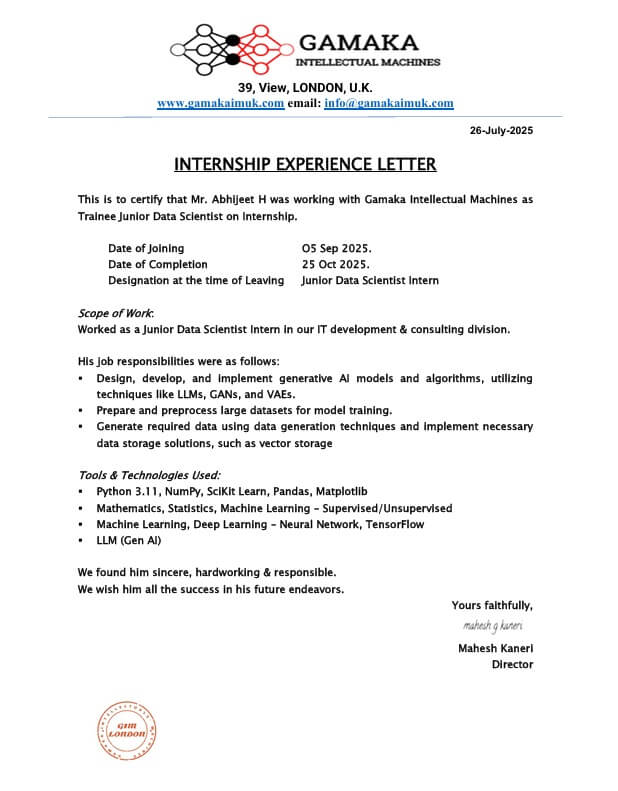
Internship Certificate

This certificate will be issued to those pursuing internships with our development team or clients with whom we have tie-ups. Data Science Internship gives opportunity to learn from professionals, gainĀ practical experienceĀ in this field, and build aĀ robust professionalĀ network.

Take First Step Towards
Your IT Dream Today

High Demand

Business & Data Analytics is a booming field with high demand and growth. You’ll gain coveted skills, solve real business problems, and contribute to success. BDA offers lucrative salaries, career flexibility across industries, and the chance to continuously learn in an ever-evolving field. Launch your rewarding career in data today!

WHY PURSUE A DATA SCIENCE CAREER
Who can take this course

This course caters to beginners with no prior coding experience (we’ll teach you Python!), career changers looking for a data field entry point, Subject Matter Experts (SMEs) seeking to leverage data analysis in their domain, and even busy working professionals with flexible online, offline, and hybrid learning options, including weekend batches.

Hands-on Projects & Internship

Gain practical experience by real-world projects and participating in an internship.

Expert Instructors

Learn from data science professionals with real-world experience who will guide you through the program and answer your questions.

Industry Based Curriculum

Our curriculum is designed to equip you with the specific skills and knowledge that are in high demand by today’s data science employers.

100% Placement

We’ll equip you with the skills and support you need to land your dream data science job.

Real World Case Studies

Immerse yourself in real-world scenarios by exploring how data science is applied in various industries.

Extensive coverage on AI Tools

Use AI to clean, transform, and organize data efficiently. Saves time spent on repetitive data tasks.

Enquire Now

Free consulting from our expert

Take First Step Towards
Your IT Dream Today